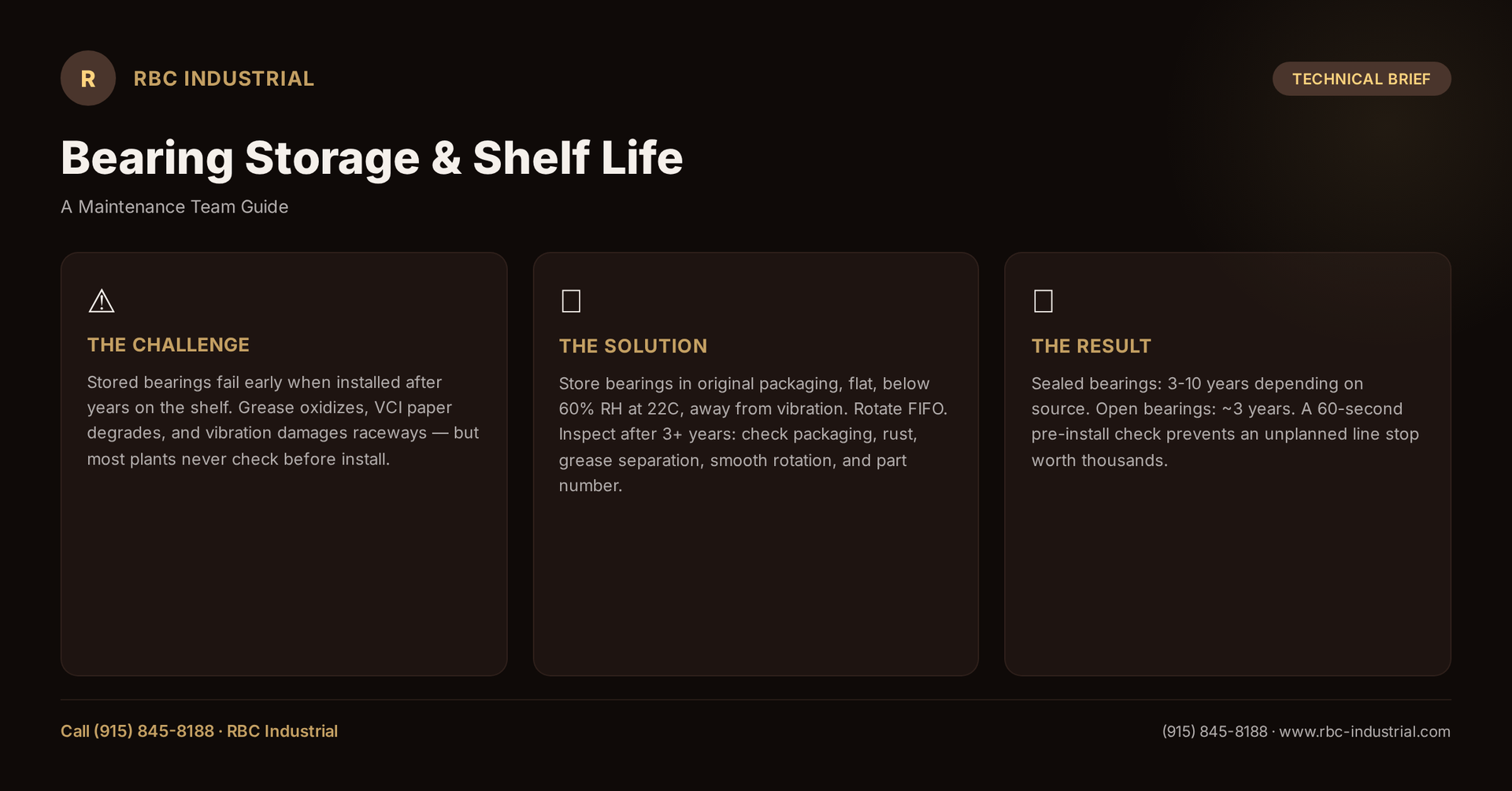
Bearing Storage and Shelf Life: What Maintenance Teams Need to Know
Unplanned downtime rarely comes from a bearing that was installed yesterday. More often, it comes from a bearing that sat in a storeroom for years and was installed without question. Bearing storage is a real engineering discipline — and getting it wrong costs plants thousands in premature failure.
This guide covers how long bearings actually last in storage, how to store them correctly, and how to tell whether a stored bearing is still safe to install.
How Long Do Bearings Last in Storage?
The answer depends on the bearing type and its lubrication. There is no single shelf life:
| Bearing Type | Shelf Life | Limiting Factor |
|---|---|---|
| Open bearings (no seals or shields) | ~3 years | Preservative coating degrades |
| Sealed / shielded bearings | 3–10 years | Grease oxidation — SKF recommends max 3 years |
| Grease-lubricated | Up to 3 years | Oil-thickener separation in the grease |
| Oil-lubricated | Up to 10 years | Slower degradation than grease |
Note on sources: SKF is the most conservative (3-year maximum for sealed bearings). NSK and other manufacturers cite 5–10 years under ideal conditions. For critical applications, treat 3 years as the safe threshold — for non-critical spares, 5 years is defensible if storage conditions are verified.
Correct Storage Conditions
- Keep bearings in original packaging. The manufacturer's wrapping, VCI paper, and oiled kraft are designed to protect against corrosion and contamination. Never remove a bearing from its box for display.
- Store flat, not on edge. Bearings stored on their side can distort under their own weight over long periods.
- Control temperature and humidity. Target below 60% relative humidity at 22°C (72°F). Avoid temperature swings that cause condensation inside packaging.
- Keep them vibration-free. Store away from compressors, presses, and forklift traffic lanes. False brinelling — fretting damage from micro-vibration — can destroy a bearing in its box.
- Rotate stock FIFO. Oldest bearings out first. Tag incoming stock with the receipt date.
- Inspect after 3+ years. Before installation, check for rust, discolored grease, or packaging damage.
Is That Stored Bearing Safe to Install?
Before installing any bearing that has been in storage more than a year, run this check:
- [ ] Packaging intact — no tears, stains, or moisture beads on the VCI paper
- [ ] No visible rust on exposed races or rollers
- [ ] Grease (if sealed) has not separated — no oil pooling at the seal edge
- [ ] Bearing rotates smoothly with no grit feel or flat spots
- [ ] Part number and date code legible — confirm it's the right spec
- [ ] No evidence of vibration damage (false brinelling) on the raceways
If the bearing fails any check, do not install it in critical equipment. The cost of a replacement bearing is trivial next to the cost of an unscheduled line stop.
Why This Matters for Your Storeroom
A well-managed bearing inventory is a hedge against downtime — but only if the spares are actually installable when you need them. Plants that treat their bearing shelf as a black box routinely discover, mid-breakdown, that the "emergency spare" has been sitting for six years in a humid warehouse bay.
At RBC Industrial, our bearing stock is rotated continuously — we move more volume, so our shelves hold fresh product, not museum pieces. And when you need a specialty or obsolete bearing fast, our engineer-led team cross-references across brands and surplus networks to find the right part in hours, not weeks.
Need a bearing spec verified or a hard-to-find size sourced? Call RBC Industrial at (915) 845-8188 or visit www.rbc-industrial.com.