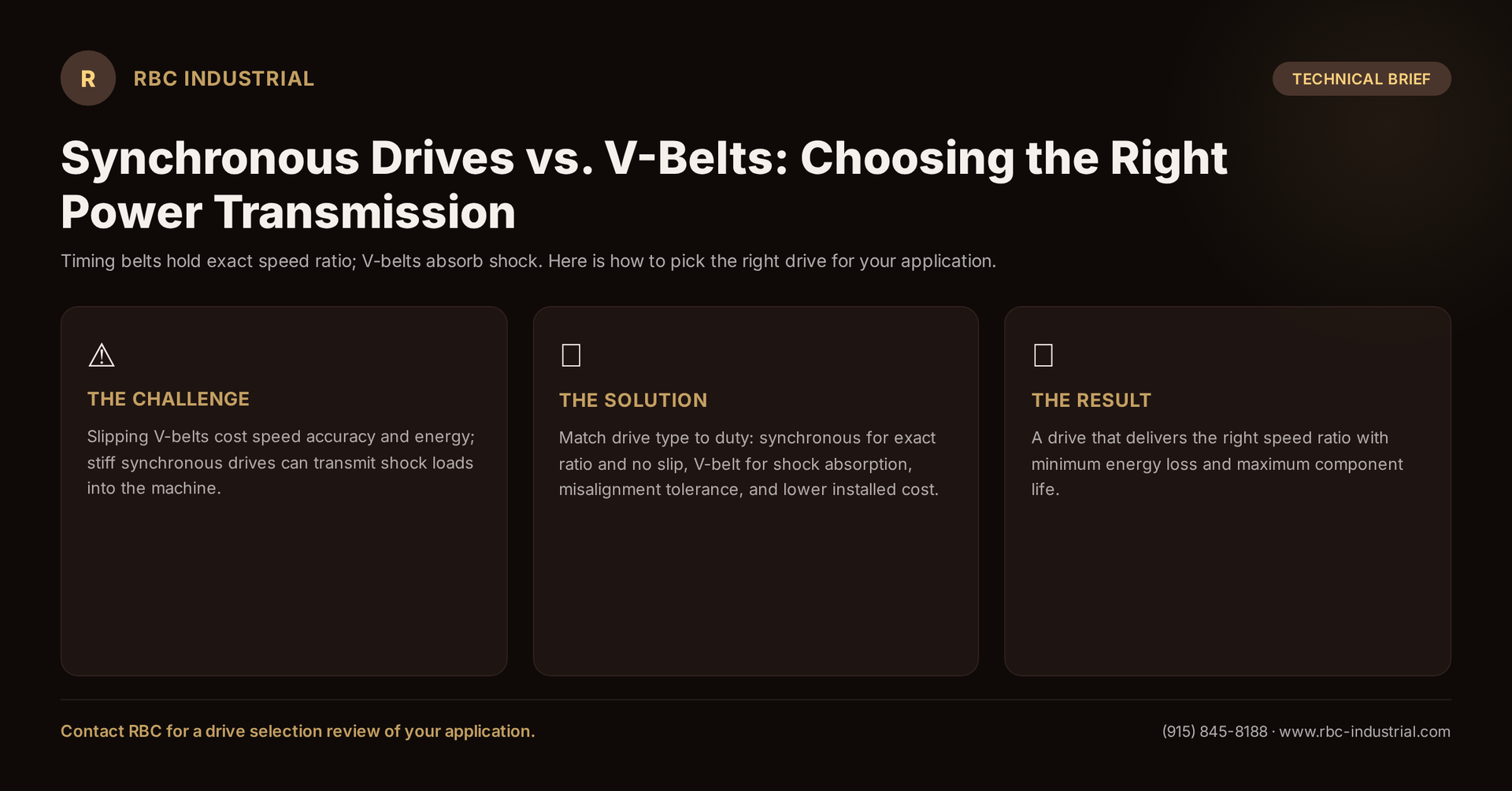
Two Families, Two Jobs
When a plant needs to move power from a motor to a machine, the belt drive is usually the most economical choice. But "belt drive" covers two very different technologies:
- V-belts — friction-based drives using 3V/5V/8V or classical sections, with sheaves and bushings.
- Synchronous (timing) belts — positive-engagement drives with toothed belts and timing pulleys that lock in an exact speed ratio.
When a V-Belt Drive Is the Right Call
V-belts excel at absorbing shock loads — the motor can slip momentarily under a hard start or jam, protecting the drive train. They also tolerate moderate misalignment, are inexpensive to replace, and use components (sheaves, bushings) that are easy to source and maintain. For fans, blowers, compressors, and general line shafts, a properly sized V-belt drive is hard to beat.
Key spec inputs: motor HP, driven RPM, center distance, and belt section. The taper-bushed sheave system (1108 through 3020 bushings) makes sizing and field changes straightforward.
When a Synchronous Drive Is the Right Call
Synchronous drives have zero slip — the belt teeth engage the pulley grooves, so the output speed ratio is fixed exactly. That makes them ideal for:
- Precision feed and index applications where ratio accuracy matters.
- Energy-sensitive drives — no slip means no friction loss at the belt interface.
- High-torque, low-speed applications where V-belts would need many grooves.
Timing pulleys come in a range of pitches (MXL, XL, L, H, XH and metric variants), and the synchronous drive catalog includes both imperial and metric sections.
The Trade-Off
Synchronous drives cost more up front, transmit shock loads directly into the driven machine, and require tighter alignment. V-belts are cheaper and more forgiving but waste a little energy and cannot guarantee exact ratio. Choosing correctly means weighing duty cycle, shock, alignment capability, and ratio accuracy — not just price.
Related catalog item: RBC Industrial stocks V-belt sheaves (taper-bushed, QD, MST), variable-pitch sheaves, synchronous timing pulleys, and complete synchronous drive catalogs in inch and metric pitches. We can lay out the whole drive from your motor and machine data.
Talk to our team about your drive — we will recommend the right family, size it, and get you part numbers.