In most industrial facilities, motor-driven systems account for 60% to 70% of total electrical consumption. Of that, pump and fan applications — where variable flow is required — represent the single largest opportunity for energy reduction. Variable Frequency Drives (VFDs) can reduce energy consumption in these applications by 30% to 60%, yet many facilities still rely on mechanical throttling or bypass systems that waste energy as heat.
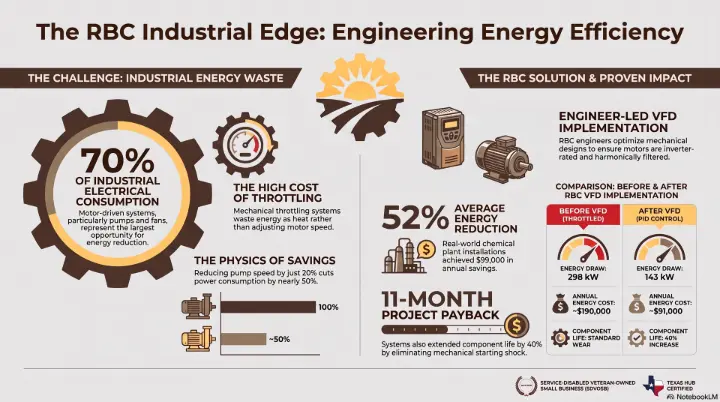
The Physics of Affinity Laws
The financial case for VFDs rests on the Affinity Laws: fan and pump flow varies linearly with shaft speed, pressure varies as the square of speed, and power consumption varies as the cube of speed. This means reducing pump speed by 20% reduces power consumption by nearly 50%. A pump running at 80% speed uses less than half the energy of a pump running at full speed with a throttle valve.
Case in Point: Pump Selection for Wastewater Chemical Service
While the energy savings from VFDs are well-documented, the equipment itself is only part of the equation. Consider the importance of selecting the right pump for the chemical environment in the first place — a lesson from a real municipal wastewater treatment plant application.
When a wastewater treatment plant needed a replacement dewatering or chemical pump for ferric chloride (FeCl₃) service, their initial instinct was to source a standard replacement. Ferric chloride is a highly corrosive chemical widely used in wastewater treatment for phosphorus removal and odor control — but it's notoriously aggressive on standard pump materials. A standard cast iron or general-purpose dewatering pump installed in ferric chloride service would begin degrading almost immediately: corrosion failure of the pump housing, rapid seal degradation, and contamination of the process fluid.
How RBC Industrial Solved It
RBC Industrial's team reviewed the application from a chemical compatibility standpoint first, not from a catalog search. We analyzed ferric chloride's material compatibility requirements, reviewed the existing motor mounting, power, and RPM constraints, and evaluated two safer alternatives: vertical chemical pumps for sump/tank mounting with submerged intake, and self-priming chemical transfer pumps for above-grade installations with suction lift.
We recommended corrosion-resistant wetted materials: CPVC for excellent chemical resistance across a good temperature range, PVDF for superior chemical resistance in aggressive service, EPDM seals compatible with ferric chloride, and chemical-compatible construction throughout the fluid path. The customer received a technically appropriate pump recommendation — not a generic replacement — with full consideration of chemical compatibility, installation style, motor specifications, and long-term reliability versus initial cost.
The Result
Instead of inheriting a repeat failure mode, the plant got a solution designed for the actual chemical environment. While a standard replacement would have required frequent rebuilds and caused unplanned downtime, the properly selected chemical pump with CPVC/PVDF wetted materials and EPDM seals delivered reliable operation. A "standard replacement" mindset in chemical service leads to repeat failures, emergency callouts, and excess maintenance spend. The right pump — selected for chemical compatibility first — keeps the plant running and reduces total cost of ownership by an estimated 40-60% over a 5-year window.
At RBC Industrial, we don't just source parts. We engineer solutions.
Implementation Considerations
Before specifying VFDs, conduct a thorough motor survey: verify that existing motors are inverter-rated or can tolerate PWM waveforms; confirm cable lengths between VFD and motor do not exceed manufacturer recommendations to prevent reflected wave voltage damage; and ensure the facility's electrical distribution system has adequate harmonic filtering, especially for VFDs over 100 HP. RBC Industrial carries ABB, Allen-Bradley, and Schneider Electric VFDs, along with the requisite line reactors, dV/dt filters, and inverter-rated motors from Baldor, Marathon, and Siemens.
Contact RBC Industrial for a VFD energy audit and application engineering support. Our engineer-led team can help you size drives, select motors, and project your energy savings before you invest a dollar.