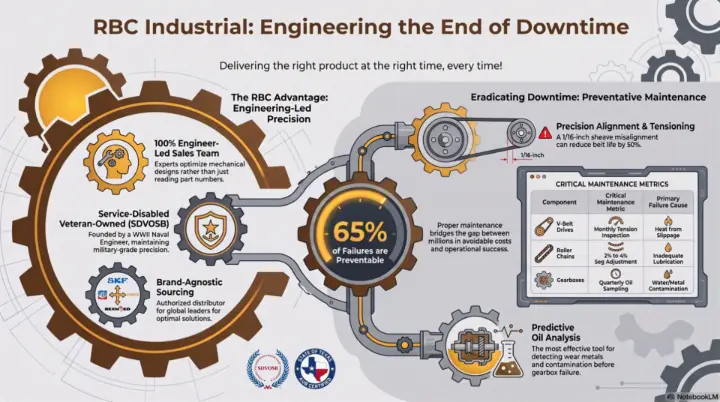
Power transmission components — belts, chains, sprockets, sheaves, couplings, and gearboxes — form the mechanical backbone of every industrial facility. According to industry data, 65% of power transmission failures are preventable through proper maintenance practices. Yet the same data shows that fewer than 30% of facilities have a documented PM program for mechanical drive components. The gap between what's possible and what's practiced represents millions in avoidable downtime and replacement costs.
Belt Drive Maintenance
V-belt drives are the most common — and most neglected — power transmission component in industry. Three maintenance practices deliver the highest return. Tension inspection: Belts lose tension as they seat during the first 24-72 hours of operation. Re-tension after initial run-in, then inspect monthly. A belt that slips generates heat that accelerates age hardening and cracking. Sheave alignment: Misaligned sheaves cause uneven belt wear, vibration, and premature failure. Use a straightedge or laser alignment tool — a 1/16-inch misalignment can reduce belt life by 50%. Multiple belt sets: When replacing belts on a multi-belt drive, always replace as a matched set. Mixing old and new belts concentrates load on the tighter belts, causing premature failure of the entire set.
Chain Drive Best Practices
Roller chain drives require different attention. Lubrication: The leading cause of roller chain failure is inadequate lubrication. Use the correct viscosity oil for the application — not grease, which cannot penetrate the pin-bushing interface. Sag adjustment: Roller chain sag should be 2% to 4% of the center distance between sprockets on the slack span. Too tight increases bearing loads and accelerates wear; too loose causes whipping and sprocket tooth wear. Sprocket inspection: Inspect sprockets for hooked-tooth wear pattern during every chain replacement. A worn sprocket will destroy a new chain in a fraction of its normal life.
Gearbox Reliability
Gearboxes represent the highest capital investment in any power transmission system. Oil analysis is the single most effective PM tool — detecting wear metals, water contamination, and viscosity breakdown before failure occurs. For gearboxes in continuous service, sample oil quarterly. Look for: increases in iron and chromium (gear and bearing wear), silicon (seal leakage and contamination ingress), and water content above 200 ppm (emulsification and lubricity loss).
Brand Agnostic — One Source for All
RBC Industrial stocks power transmission components across all major brands — SKF, Timken, Morse, Browning, Bonfiglioli, Rexnord, Gates, Martin, and Dodge. Our engineer-led team can help you standardize on a single brand across your facility or maintain multiple brands for redundancy. Same-day response on stock items, with technical verification of fit before shipment.
Contact RBC Industrial to request a power transmission PM program review or to order replacement components.