
Is That Pressure Gauge a Standard Replacement? Let's Verify
A case study in field identification and diaphragm seal assemblies
The Problem
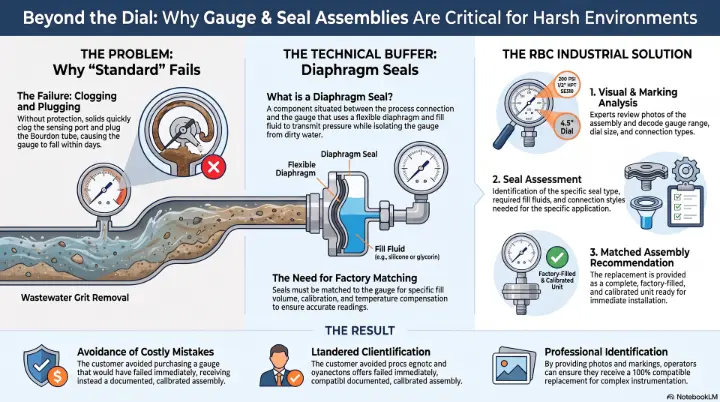
A wastewater treatment plant needed a replacement pressure gauge on their grit removal system. At first glance, it looked like a standard gauge — a common instrumentation item any supply house could quote.
But this wasn't a standard gauge application. The system handled grit-laden wastewater with sand, gravel, and abrasive solids. A standard pressure gauge would fail within days as solids clogged the sensing port and plugged the Bourdon tube.
The Technical Challenge
The assembly included a diaphragm seal — a critical component that isolates the gauge from the process media. The diaphragm seal sits between the process connection and the gauge, using a flexible diaphragm and fill fluid to transmit pressure without exposing the gauge to dirty water. It must be factory-matched to the gauge for fill volume, calibration, and temperature compensation.
How RBC Industrial Solved It
- Visual review: Examined photos of the existing assembly — gauge, seal, connection, and piping
- Markings analysis: Decoded gauge range, dial size, connection type, and manufacturer markings
- Diaphragm seal assessment: Identified the seal type, fill fluid requirements, and connection style
- Complete assembly recommendation: Determined the replacement should be quoted as a matched, factory-filled, and calibrated gauge + diaphragm seal assembly
The Result
The customer avoided a costly mistake. Instead of ordering just a gauge that couldn't do the job, they received a complete, matched assembly ready for installation with factory calibration documentation.
Not sure what you're looking at? Send RBC Industrial photos and markings of your existing instrumentation. We'll identify the full assembly and get you a complete replacement quote.