Confined Space Communication: Choosing the Right Radios for Manhole Operations
A case study in safety-focused equipment sourcing
The Problem
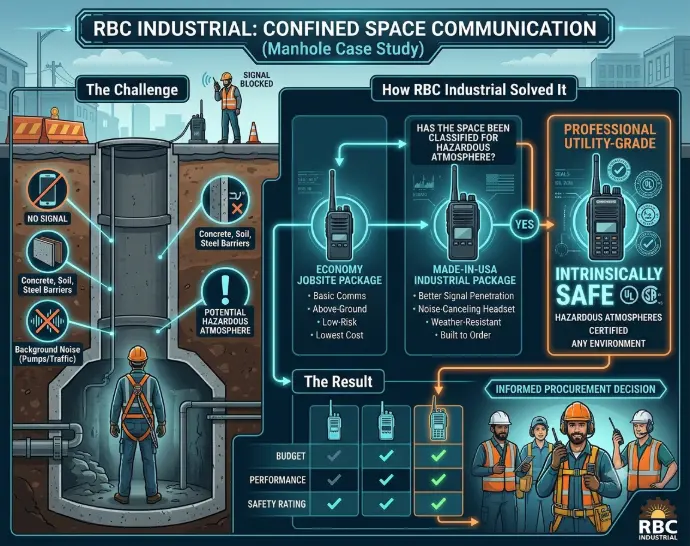
A municipal water utility needed reliable communication between operators working inside a manhole and the crew on the surface. Operators underground can't see or hear surface personnel. Standard cell phones often have no signal below grade. Two-way radios must work through concrete, soil, and steel — safely, in a potentially hazardous atmosphere.
The Technical Challenge
Confined-space communications require solving multiple constraints simultaneously: signal penetration through concrete, audio clarity against background noise, hands-free operation, durability in wet environments, and the critical question of intrinsic safety if combustible gas might be present.
How RBC Industrial Solved It
Rather than pushing a single recommendation, RBC Industrial presented three distinct package levels with clear trade-offs:
- Economy Jobsite Package: Low-risk, non-hazardous above-ground work. Basic two-way radios, lowest cost.
- Made-in-USA Industrial Package: Regular confined-space entry. Better signal penetration, noise-canceling headsets, weather-resistant.
- Professional Utility-Grade (Intrinsically Safe): Hazardous atmospheres. UL/CSA/ATEX certified, can be used in any environment.
RBC also highlighted the critical decision point: has the confined space been classified for hazardous atmosphere? If yes, intrinsically safe radios are mandatory — not optional.
The Result
The customer received a clear, side-by-side comparison of communication solutions mapped to budget, performance, and safety requirements — enabling an informed procurement decision.
Need communication equipment for confined-space operations? Contact RBC Industrial. We'll help you evaluate options based on your actual work environment, safety requirements, and budget.