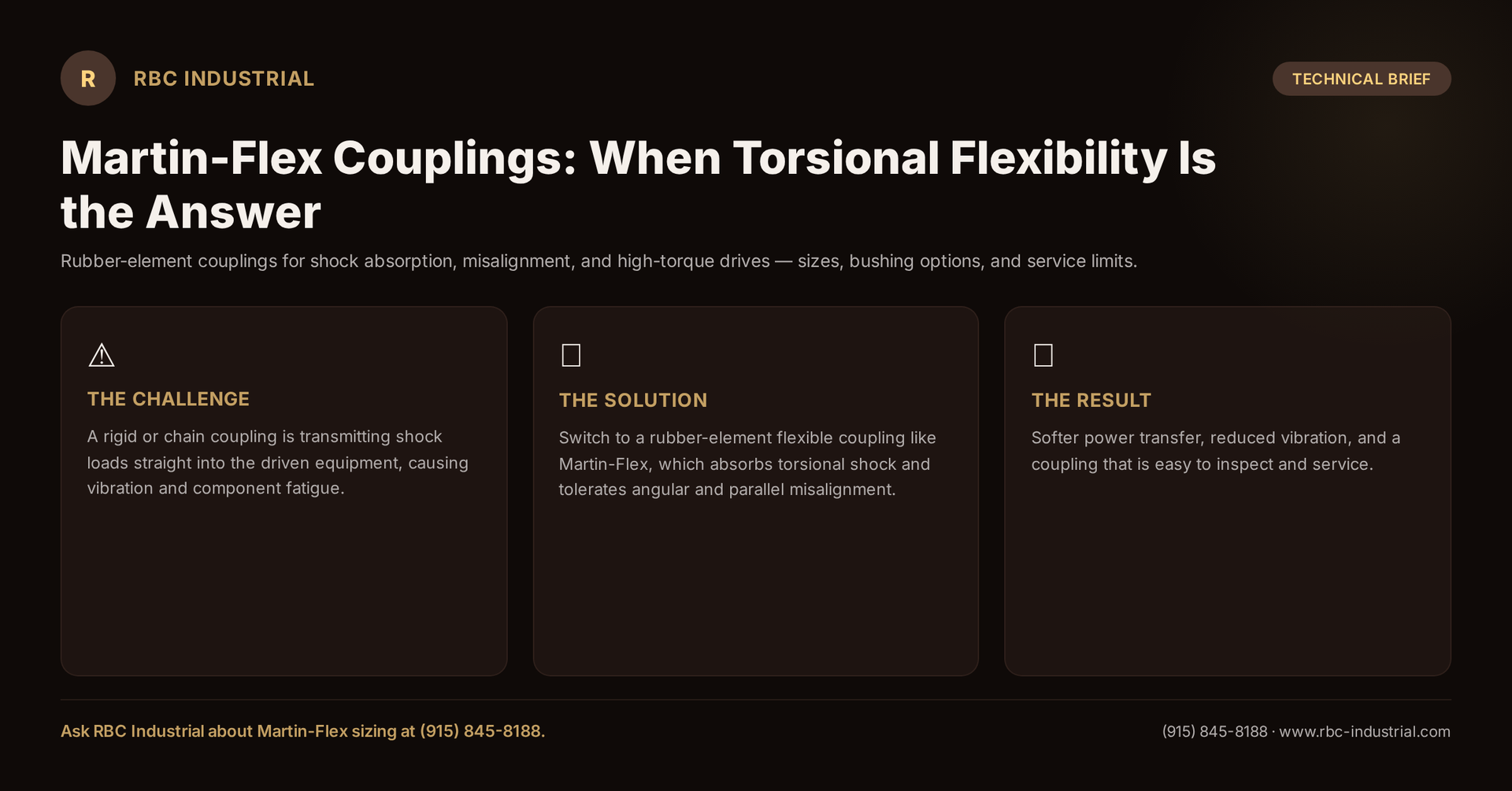
El caso de un acoplamiento con elemento de caucho
No todos los problemas de acoplamiento necesitan más acero. Cuando una transmisión transmite cargas de choque (una trituradora golpea una roca, un compresor golpea sobre picos de presión, un transportador que arranca con carga completa), un acoplamiento rígido o de cadena transmite esos impulsos directamente a la caja de cambios y a la máquina accionada. Un acoplamiento de elementos de caucho como la serie Martin-Flex se flexiona deliberadamente, absorbiendo los golpes de torsión y amortiguando las vibraciones antes de que lleguen al equipo. Para muchas plantas, ese único cambio extiende la vida útil de las cajas de engranajes, rodamientos y ejes impulsados.
Lo que Martin-Flex aporta al variador
El acoplamiento Martin-Flex es un acoplamiento bridado con un elemento de goma entre las dos bridas. El elemento es la pieza de desgaste reemplazable: sin lubricación, sin contacto de metal con metal y sin necesidad de mover la máquina cuando el elemento se desgasta. El catálogo enumera los datos de servicio clave para cada tamaño: RPM máximas, caballos de fuerza a 100 RPM con un factor de servicio de 1.0, clasificación de torsión y rigidez torsional estática promedio. Los tamaños van desde el tamaño compacto 5 (diámetro máximo de 1 pulgada, 4500 RPM, aproximadamente 1 HP a 100 RPM) hasta el tamaño 12 y más allá, donde los diámetros alcanzan las 2-7/8 pulgadas y las clasificaciones de torsión suben a miles de lb-in.
Cada tamaño utiliza un buje QD específico (patrón JA, SH, SDS, SK, SF o E), lo que significa que la misma familia de bujes que ya está en stock para poleas y piñones se adapta al acoplamiento. Los elementos de caucho en sí están codificados por colores o números por tamaño (E5 a E12 y superiores), por lo que reordenar la pieza de desgaste es un número de pieza de una línea.
Tamaño y selección
La selección sigue la misma lógica de factor de servicio que otros acoplamientos: multiplique los HP del motor por el factor de servicio de la unidad impulsada, luego elija el tamaño cuya potencia nominal a su velocidad de operación cumpla o exceda la cifra ajustada. Debido a que Martin-Flex tiene una clasificación de factor de servicio de 1,0 en sus tablas publicadas, la aplicación del factor correcto de la clasificación de la unidad genera automáticamente el margen de carga de impacto.
Notas de instalación
El catálogo menciona algunos detalles prácticos. Los extremos del eje normalmente están separados en M o N y pueden sobresalir más allá de los bujes; deje espacio para la flotación del extremo y la desalineación. Los conjuntos de bridas utilizan tornillos de cabeza de Grado 8 apretados según los valores de la tabla (desde 125 in-lb en el tamaño 5 hasta 900 in-lb en el tamaño 12). Cuando llega el momento de retirar el acoplamiento, los tornillos de cabeza extraíbles funcionan como tornillos niveladores. El elemento de goma se puede inspeccionar con una simple comprobación visual: las grietas, la falta de trozos o el fraguado permanente significan reemplazo.
RBC Industrial cuenta con acoplamientos, elementos y casquillos QD Martin-Flex. Llame al (915) 845-8188 o visite www.rbc-industrial.com para obtener ayuda con el tamaño y cotizaciones el mismo día.