
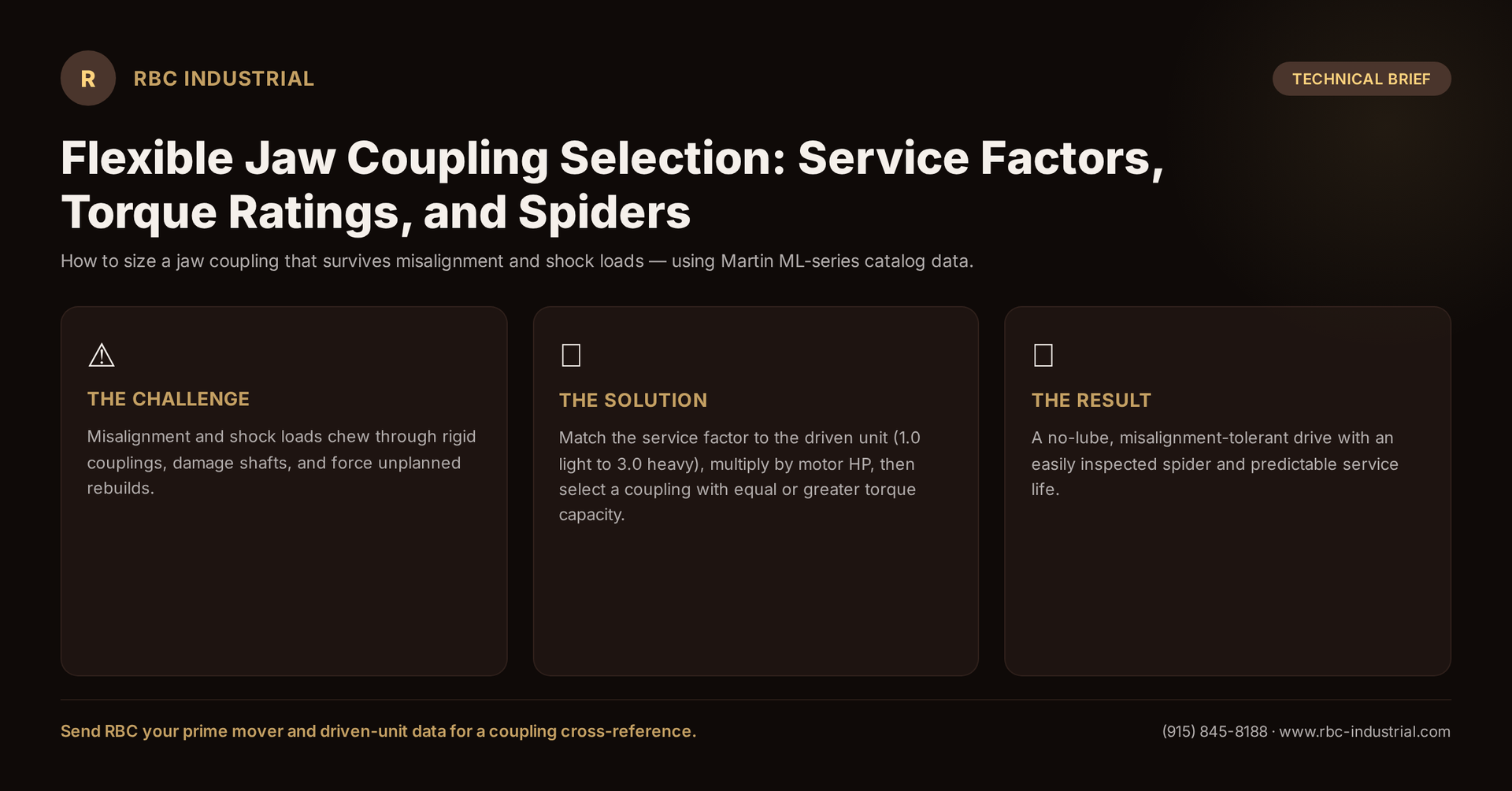
Por qué se pasa por alto la selección del acoplamiento
Los acoplamientos son pequeños, económicos y fáciles de ignorar, hasta que uno falla. Sin embargo, el proceso de selección es sencillo si se sigue el método del catálogo.
Paso 1: Determine el factor de servicio
Cada catálogo de acoplamientos flexibles, incluidas las existencias de RBC de datos de la serie ML de Martin, comienza con una tabla de factores de servicio. El factor depende de la unidad impulsada y del motor principal:
- 1,0–1,5 (ligero): cargas uniformes y estables: agitadores, sopladores, bombas centrífugas, ventiladores, generadores.
- 1,5–2,5 (moderado): inercia fuerte o impacto moderado: bombas rotativas, compresores, grúas, máquinas herramienta, mezcladores.
- 2.0–3.0 (Pesado): Cargas de choque o reversas frecuentes: bombas alternativas, trituradoras, molinos de bolas, cribas vibratorias, punzones, cizallas.
Paso 2: Calcule los caballos de fuerza ajustados
Multiplique el factor de servicio por los caballos de fuerza de la unidad impulsada (o del motor). Esto proporciona el HP ajustado que el acoplamiento debe manejar.
Ejemplo: un motor de 20 HP que impulsa una bomba alternativa (factor de servicio 2,0) necesita un acoplamiento con capacidad nominal de al menos 40 HP, no 20 HP. Seleccionar únicamente el HP de la placa de identificación es el error de tamaño más común que vemos.
Paso 3: Haga coincidir la clasificación de torque y la araña
Usando los datos de la serie ML: el ML035 comienza en 3,5 lb-in de torque, y el rango aumenta hasta el ML276 a 7,860 lb-in. El miembro que soporta la carga es la araña:
- Arañas Buna-N: de uso general, resistentes al aceite y la suciedad, buena amortiguación.
- Arañas Hytrel®: mayor capacidad de torque y mejor resistencia química para trabajos exigentes.
Las tolerancias de los orificios también importan: los orificios estándar son +0,001/–0,000 para diámetros de hasta 1,75" y +0,0015/–0,0000 para diámetros de hasta 1,75" 1,8125" a 2,625". Un ajuste de orificio descuidado convierte un acoplamiento flexible en un generador de vibración.
El resultado: una unidad que puede ignorar (en el buen sentido)
Los acoplamientos de mordaza del tamaño adecuado no necesitan lubricación, permiten la desalineación angular y paralela dentro de los límites de la araña y proporcionan una fácil inspección del miembro que soporta la carga. Esto se traduce directamente en menores costos de mantenimiento y menos paradas no planificadas.
Artículo de catálogo relacionado: RBC Industrial almacena acoplamientos de mandíbula Martin (series ML y MS), acoplamientos de cadena de rodillos, acoplamientos Quadra-Flex y go-flex, y catálogos completos de acoplamientos con datos de orificios y chaveteros. Ya sea que necesite una araña de repuesto o una especificación completa del tren motriz, podemos realizar referencias cruzadas entre fabricantes.
Envíenos los caballos de fuerza de su motor, la unidad impulsada y los tamaños de eje; dimensionaremos el acoplamiento antes de realizar el pedido.