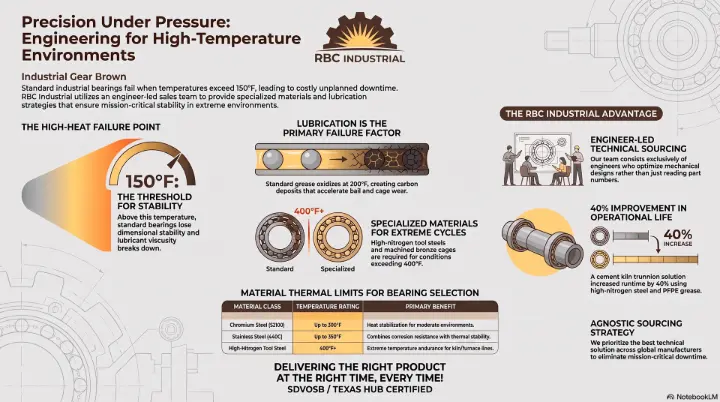
Cuando las temperaturas de funcionamiento superan los 150 °F (65 °C), las configuraciones de rodamientos estándar comienzan a perder estabilidad dimensional, la viscosidad del lubricante disminuye y los materiales de la jaula se degradan. Para las instalaciones industriales que utilizan hornos, secadores, hornos o líneas de procesamiento de alta velocidad, seleccionar el rodamiento incorrecto puede significar un tiempo de inactividad no planificado medido en días en lugar de horas.
Comprensión de los umbrales de temperatura
Los rodamientos de acero convencionales con lubricación con grasa estándar están clasificados. para funcionamiento continuo hasta aproximadamente 200 °F (93 °C). Más allá de este umbral, el aceite base de la grasa se oxida y forma depósitos de carbón que impiden el movimiento de la bola y aceleran el desgaste. Para aplicaciones que requieren temperaturas sostenidas de 250 °F a 400 °F (121 °C a 204 °C), los ingenieros deben especificar materiales especializados y estrategias de lubricación.
Opciones de materiales para servicio de alta temperatura
RBC Industrial cuenta con múltiples series de rodamientos diseñados para entornos de temperatura elevada. Las clases de materiales clave incluyen: Acero al cromo (52100) con estabilización térmica especial para calor moderado hasta 300 °F; Acero inoxidable martensítico (440 C) que ofrece resistencia a la corrosión con una vida útil de hasta 350 °F; y Aceros para herramientas con alto contenido de nitrógeno para condiciones extremas que superan los 400 °F. Los materiales de las jaulas pasan del acero o latón estándar al bronce mecanizado o PEEK (polieteretercetona), los cuales mantienen la estabilidad dimensional a temperaturas elevadas.
Estrategia de lubricación: el factor crítico
A temperaturas elevadas, la selección del lubricante es más importante que el material del cojinete. Las grasas PFPE (perfluoropoliéter) mantienen la estabilidad a 500 °F. Los aceites de hidrocarburos sintéticos con espesantes ofrecen una solución rentable hasta 350 °F. Para calor extremo, los lubricantes de película sólida como el disulfuro de molibdeno (MoS₂) brindan protección de capa límite donde ningún lubricante líquido puede sobrevivir.
Caso del mundo real: reemplazo de rodamientos obsoletos para una planta de procesamiento de alimentos en Texas
Cuando una planta procesadora de alimentos en San Antonio tuvo una falla en su transportador principal (un rodamiento de rodillos esféricos SKF especial que había sido descontinuado por el fabricante), su proveedor nacional habitual citó entre 8 y 10 semanas de anticipación. tiempo. Cada hora de inactividad cuesta aproximadamente 7.500 dólares en producción perdida. Pérdida potencial total: más de 1 millón de dólares si la línea permaneciera inactiva durante todo el plazo de entrega.
El gerente de mantenimiento tenía tres opciones: esperar 8 semanas (inaceptable), modernizar un rodamiento diferente que requería mecanizado (más de 2 semanas de ingeniería) o encontrar un reemplazo obsoleto: el camino menos disruptivo.
Cómo lo resolvió RBC Industrial
El equipo de ingeniería de RBC Industrial tomó la hoja de especificaciones y la comparó con nuestra red de proveedores especializados, inventarios excedentes y equivalentes entre fabricantes. En 30 minutos, nuestro ingeniero revisó las especificaciones e identificó tres posibles referencias cruzadas. Al cabo de 1 hora y 45 minutos, confirmamos una coincidencia exacta de un distribuidor excedente de nuestra red. El rodamiento se extrajo, inspeccionó y verificó NOS (nuevo stock antiguo) en 2,5 horas. Al cabo de cuatro horas, el rodamiento estaba cargado para su entrega a San Antonio. Al cabo de seis horas, se instaló el rodamiento y la línea volvió a estar en línea.
El resultado
Mientras que el proveedor nacional citó un plazo de entrega de 8 a 10 semanas, RBC Industrial entregó en 4 horas. El costo fue de $2300 por el rodamiento (la misma pieza) con $0 de honorarios de ingeniería. Cero tiempo de inactividad no planificado, frente a una pérdida potencial de más de 1 millón de dólares. La combinación de un equipo dirigido por ingenieros que conoce los rodamientos más allá de los números de piezas, una red de abastecimiento entre fabricantes que no depende del catálogo de una sola marca y una respuesta en el mismo día con sede en Texas marcó la diferencia.
Este no es un escenario hipotético. Los componentes obsoletos y pendientes de entrega son una realidad eventual para todas las instalaciones industriales de Texas. Cuando esto sucede, tener un distribuidor que pueda hacer referencias cruzadas entre marcas, abastecerse de inventarios excedentes y especializados, y entregar el mismo día dentro de Texas puede significar la diferencia entre una breve interrupción y un desastre de un millón de dólares.