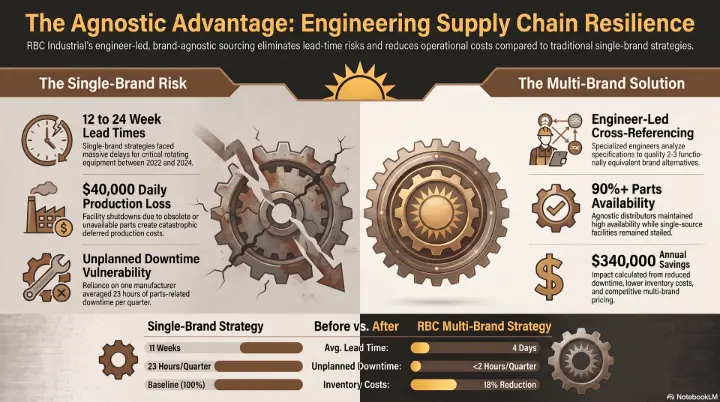
When supply chain disruptions hit the industrial sector in 2022-2024, facilities that relied on single-brand sourcing strategies faced 12- to 24-week lead times on critical rotating equipment components. Facilities that worked with agnostic distributors — suppliers that can source across SKF, Timken, Morse, Browning, Bonfiglioli, Rexnord, Dodge, Martin, and Gates — maintained 90%+ availability through the same period. The lesson is clear: brand flexibility is supply chain resilience.
Real Case: Hard-to-Find Monel 400 Tubing for Chemical Service
When a municipal water/wastewater facility had a critical application handling dry hydrochloric acid (HCl) gas — a chemical that destroys standard materials in short order — they needed Monel 400 tubing in multiple sizes, compatible corrosion-resistant fittings, proper material certification and traceability, and packaging and freight coordination for fragile, high-value alloy components.
This wasn't a call to a plumbing supply house. Monel 400 is a nickel-copper alloy specifically designed for reducing chemical environments like hydrochloric and hydrofluoric acids. It's expensive, hard to source, and requires knowledgeable handling. The wrong material would fail catastrophically. The right material required a supply chain that most distributors can't access.
How RBC Industrial Solved It
RBC Industrial approached this as a materials supply chain project, not a parts order. We verified the Monel 400 grade, temper, and dimensional requirements against the service conditions. We activated our supplier network to identify mills and stocking distributors with Monel 400 availability in the required sizes. During the quoting process, we caught and corrected pricing inconsistencies — a common issue with exotic alloys where market pricing fluctuates significantly. We specified proper boxing and crating to protect thin-wall tubing during transit, and coordinated timing across multiple suppliers to minimize freight costs and delivery complexity.
The Result
The customer received a clear, verified sourcing path for difficult-to-find corrosion-resistant material with correct alloy grades and proper traceability. Packaging protected the product in transit, and coordinated delivery eliminated the usual "multiple truckload" headache. What didn't happen: the customer didn't receive damaged tubing, wrong alloy, or a "sorry, we can't source it" email.
This pattern repeats across different categories. In another case, a manufacturing customer needed specific automation and HMI components — Siemens and other European-manufactured controls with limited North American availability. Standard distributors showed zero stock. Lead times from the factory were uncertain. RBC Industrial located the requested automation components through international supply channels, verified availability and compatibility, coordinated sourcing to meet the customer's production timeline, and handled cross-border logistics. The customer received hard-to-find automation components without production delays — sourced through channels beyond standard local distribution.
The lesson is clear: supply chain resilience comes from network depth and technical capability, not from brand-exclusive agreements.
Building Your Multi-Brand Strategy
Start by identifying single-source critical spares — components with only one qualified brand. For each, work with a brand-agnostic distributor to identify 2-3 functionally equivalent alternatives. Verify mounting dimensions, shaft configurations, and performance ratings. Document alternatives in your CMMS. And establish a relationship with a distributor that has demonstrated the engineering capability to make cross-brand substitutions without compromising reliability.
RBC Industrial's engineer-led sales team has deep cross-reference expertise across 20+ major brands. Contact us to review your single-brand risks and build a resilient multi-brand sourcing strategy.